

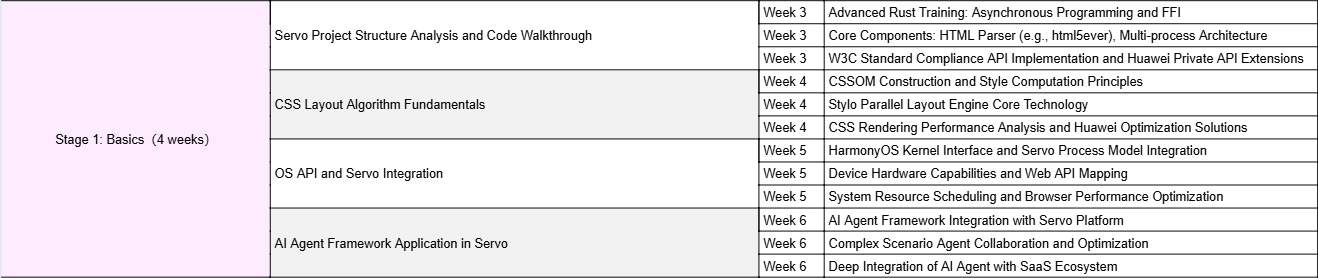
Stage 1: Basics (Weeks 3-6) Course Summary and Introduction
This phase focuses on dissecting Servo's core modules and developing system-level development capabilities, emphasizing architecture analysis, standards compliance, and Huawei ecosystem integration to establish engineering foundations for advanced phases.
Week 3: Servo Project Structure Analysis & Code Walkthrough
Core Content:
- Advanced Rust Features
- Async programming ecosystem (
async/awaitwithtokioruntime) - Cross-language interaction (FFI for C/C++ library calls, HarmonyOS kernel interface integration)
- Core Component Architecture
- HTML Parser: Tokenizer/parser pipeline design in
html5ever - Multi-process Model: IPC mechanisms (message passing & shared memory) across Browser/Renderer/GPU processes
- Network Stack: Necko's HTTP/QUIC protocol support and Huawei CloudEngine acceleration
- API Development Standards
- W3C-compliant interface implementation (e.g., WebGL context binding)
- Huawei private API extensions via WebIDL
[HongmengDevice]tags
Competency Goal: Master Servo source code debugging and cross-language interface development.
Week 4: CSS Layout Algorithm Fundamentals
Core Content:
- Style Computation System
- CSSOM construction workflow (selector matching & cascade rules)
- HarmonyOS dynamic theme system integration with CSS variables (
var())
- Parallel Layout Engine
- Stylo thread pool scheduling (DOM subtree partitioning & load balancing)
- Huawei HiAI SDK acceleration for CSS Transform matrix operations (NPU offloading)
- Rendering Diagnostics
- Layout performance heatmap generation using HiProf
- Foldable screen media query adaptation
Competency Goal: Acquire layout bottleneck identification and hardware acceleration design skills.
Week 5: OS API & Servo Integration
Core Content:
- HarmonyOS Kernel Integration
- Binder IPC adaptation for Servo's multi-process model
- Vulkan backend integration via HarmonyOS
Graphicservice
- Device Capability Mapping
- Sensor API standardization (
DeviceMotionEventvia WebIDL) - TEE-based camera/mic access control
- Resource Scheduling Optimization
- Memory management (Ark Compiler AOT optimization for Servo memory pools)
- Energy-aware rendering process prioritization using Huawei LMK
Competency Goal: Master OS-level API design and browser resource scheduling.
Week 6: AI Agent Framework Applications
Core Content:
- Framework Integration
- MindSpore Lite inference engine embedding (CSS computation offloading)
- Agent decision flows (page load prediction & resource prefetching)
- Intelligent Enhancement
- LSTM-based user behavior prediction (scroll direction & dwell time modeling)
- Model format conversion (ONNX→MindSpore) for Servo runtime
- Ecosystem Synergy
- HiAI resource scheduling API integration
- Edge-cloud collaborative inference (ModelArts cloud training + edge deployment)
Competency Goal: Develop AI-enhanced browser optimization strategies and edge inference deployment skills.
Stage Features
- Technical Depth
- Progressive learning: Language (Rust async) → Architecture (multi-process/GPU pipeline) → Algorithms (Stylo/HiAI acceleration)
- Huawei Ecosystem Integration
- Tools: HiProf diagnostics → Ark Compiler → ModelArts
- Hardware: NPU acceleration → TEE security → HarmonyOS distributed services
- Standards-Compliance & Extensions
- W3C compliance + Huawei-specific extensions (e.g.,
[HongmengDevice]tags)
This stage builds three core competencies:
- Code-level engineering (Rust/WebIDL/C++ interop)
- Performance optimization (layout algorithms/resource scheduling/hardware acceleration)
- AI engineering (edge inference & browser function integration)